10 Best Laksa in Singapore
Ten places for laksa in Singapore, from Katong stalls with spoon-eaten noodles to heritage Peranakan restaurants serving coconut-rich Nyonya laksa.
- Edited by
- Amir Wahab
- Published
- Reading time
- 5 min read
 AI image by LocalRank
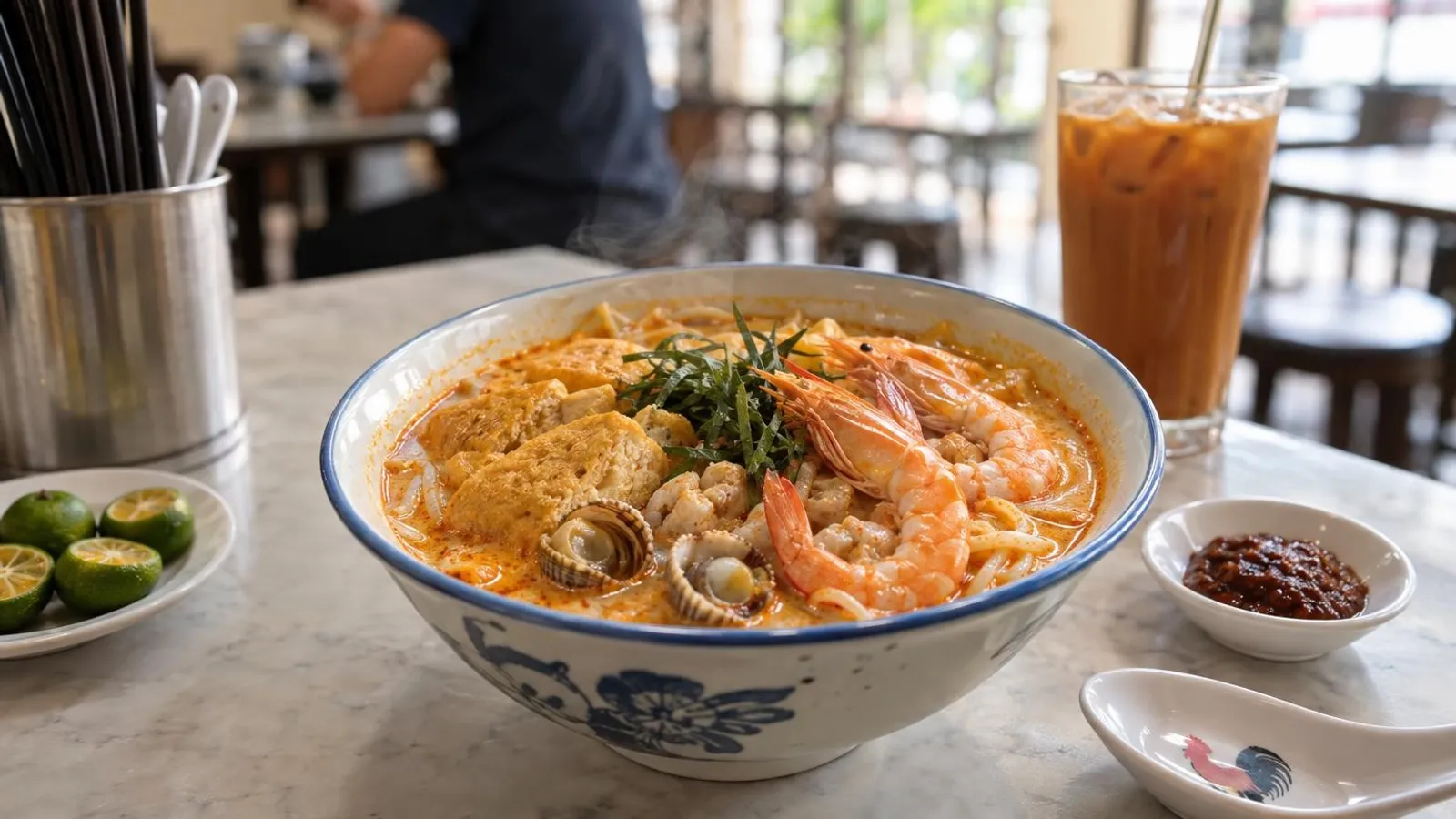
Few dishes are as fiercely debated as laksa in Singapore, where a good bowl means a coconut-rich, spice-laden gravy over rice noodles, brightened with cockles, prawns, tau pok and a scattering of laksa leaf. This guide gathers ten places for laksa in Singapore - from Katong stalls whose short-cut noodles are eaten with a spoon to heritage Peranakan restaurants - each checked against its own website or well-documented operation. Treat it as a shortlist to explore, not a strict ranking.
1. 328 Katong Laksa
328 Katong Laksa is Singapore's best-known name in Katong-style laksa, and its own site bills it as 'one of the best laksa in Singapore.' The bowl follows the Katong template: a coconut-rich, lemak gravy over short-cut thick rice noodles that you eat with a spoon alone, finished in the usual style with cockles, prawns, fish cake and beansprouts. From its original East Coast Road shophouses it has grown to several outlets across the island, including Queensway, United Square and Westgate.
East Coast Road (Katong)
Visit website ↗View on map ↗
2. Sungei Road Laksa
Sungei Road Laksa is an old-school stall now tucked into a coffee shop at Block 27 Jalan Berseh, known for still simmering its gravy over a charcoal fire - an increasingly rare sight in Singapore. Served in a small bowl with a spoon and no chopsticks, its laksa keeps the gravy comparatively light rather than heavily creamy, laced with cockles over thick rice vermicelli. It draws steady queues through the day and keeps its own schedule, closing on the first and third Wednesday of each month.
Jalan Berseh
View on map ↗
3. Depot Road Zhen Shan Mei Claypot Laksa
Depot Road Zhen Shan Mei Claypot Laksa moved from its original Depot Road location to the Alexandra Village Food Centre, where it is known for an especially rich, coconut-heavy gravy. A bowl is typically loaded in the local style with tau pok, fish cake, prawn, cockles, shredded chicken and beansprouts, the broth leaning creamy and lemak. It keeps daytime hawker-centre hours, so it is best visited for an early or midday bowl.
Alexandra Village
View on map ↗
4. Janggut Laksa
Janggut Laksa takes its name from a bewhiskered Katong hawker - janggut is Malay for beard - and styles itself 'the original Katong laksa,' claiming roots in the pushcart laksa of 1950s Katong. Now run by the founding family's descendants, its most visible stall sits on the ground floor of Queensway Shopping Centre, with other outlets around the island. It serves the classic spoon-eaten Katong bowl: a creamy, dried-shrimp-scented gravy over short noodles with prawns and sliced fish cake.
Queensway
View on map ↗
5. 928 Yishun Laksa
928 Yishun Laksa is a no-frills heartland stall in Yishun that does one thing only - laksa - and does it to long, daily queues. The bowl is a straightforward, comforting Singapore laksa: a lemak coconut gravy over rice vermicelli that regulars return to for value and consistency rather than frills. It keeps early daytime hours and can close once it sells out, so it pays to arrive before the lunch rush.
Yishun
View on map ↗
6. Famous Sungei Road Trishaw Laksa
Famous Sungei Road Trishaw Laksa takes its name in tribute to the old laksa hawkers who once plied the Sungei Road area by trishaw, and today its main stall trades from Hong Lim Market & Food Centre in Chinatown, with a second stall in the west at Yuhua. The kitchen says its gravy is built on a long-simmered stock of ingredients such as dried shrimp, prawns, dried scallops and dried oysters, giving a deep, savoury-sweet base. Bowls come in the local style over rice vermicelli, and the stall keeps daytime hours.
Chinatown (Hong Lim)
View on map ↗
7. The Blue Ginger
The Blue Ginger is a long-running Peranakan restaurant on Tanjong Pagar Road that describes itself as dedicated to preserving Nyonya cooking, which it calls a blend of 'traditional Chinese and Malay techniques and ingredients.' Among its Nyonya classics it serves laksa, the coconut-and-spice noodle dish in its Peranakan register rather than a hawker-stall bowl. It suits a sit-down meal where laksa is one plate in a broader spread of buah keluak, rendang and other heritage dishes.
Tanjong Pagar
Visit website ↗View on map ↗
8. True Blue Cuisine
True Blue Cuisine is a Peranakan restaurant beside the Peranakan Museum on Armenian Street, presenting itself as 'authentic Peranakan dining' and 'a living heritage,' set among antique Nyonya furniture and tableware. The restaurant, which says it opened in 2003 and moved to Armenian Street in 2008, serves laksa among its traditional Nyonya dishes. It is a full-service, sit-down option for a heritage-style laksa in the city rather than a quick hawker bowl.
Armenian Street
Visit website ↗View on map ↗
9. Baba Chews Bar & Eatery
Baba Chews Bar & Eatery is the all-day restaurant of Hotel Indigo Singapore Katong, set in the restored former Joo Chiat Police Station in the heart of Katong. Its modern-Asian, Peranakan-leaning menu includes a Nyonya laksa, served in a comfortable air-conditioned dining room rather than at a hawker stall. It is a convenient sit-down choice for laksa in the Katong-Joo Chiat heartland of the dish.
10. Guan Hoe Soon
Guan Hoe Soon is a Peranakan restaurant on Joo Chiat Road whose own site says it has been 'serving authentic Peranakan cuisine since 1953,' making it one of the neighbourhood's oldest Nyonya kitchens. Its menu of Peranakan home-style dishes includes laksa alongside classics such as ayam buah keluak and beef rendang. It is a traditional, sit-down setting for a Nyonya-style laksa in the Katong-Joo Chiat area.
How to choose
- Know the style you want. Katong laksa comes as short-cut thick noodles eaten with a spoon alone in a coconut-rich, lemak gravy, while other Singapore and Nyonya versions vary in spice, creaminess and toppings - so pick the profile you enjoy before you queue.
- Judge the gravy and the cockles. A good laksa gravy should taste of coconut, dried shrimp and spice rather than just chilli oil, and the cockles (hum), prawns, fish cake and tau pok should be fresh - most stalls will happily add extra or leave cockles out to taste.
- Match the setting to the occasion. Hawker stalls give the cheapest, most no-frills bowls but can mean queues, cash-only payment and early sell-outs, while Peranakan restaurants offer air-conditioned, sit-down meals where laksa is one dish among many.
- Go early and check the hours. Many laksa stalls open in the morning, keep daytime hours and close once they sell out, and some take fixed rest days, so confirm opening times before making a special trip.
- Ask about spice and customisation. Some places let you adjust the chilli or add and omit cockles, prawns or tau pok, and a little of the accompanying sambal or a squeeze of lime can lift the bowl - start mild if you are unsure of the heat.
. No changes recorded since.
Founder and Editor
Amir Wahab is the founder and editor of LocalRank, an independent Singapore rankings and local guides publication.
Read next
10 Best Biryani Places in Singapore (2026)
Find the best biryani in Singapore: ten dum, bamboo, claypot and heritage biryani places across Little India, Kampong Glam and the heartlands.
By Amir Wahab7 min read
9 Best Lebanese Restaurants in Singapore (2026)
Looking for the best Lebanese restaurants in Singapore? Nine open picks for mezze, charcoal grills and sharing platters, from Kampong Glam to the river.
By Amir Wahab6 min read
11 Best Pasta Restaurants in Singapore (2026)
Discover 11 of the best pasta restaurants in Singapore, from handmade pasta bars to casual mall favourites, with how to choose and what to check first.
By Amir Wahab8 min read
9 Best Meal Prep and Healthy Meal Delivery Services in Singapore (2026)
Compare 9 meal prep and healthy meal delivery services in Singapore, from weekly plans to macro-counted and halal options, with how to choose between them.
By Amir Wahab7 min read