How to Choose a Pest Control Company in Singapore
What the NEA licence proves, what it does not, and the questions worth asking before anyone quotes you a price.
- Published
- Last reviewed
- Reading time
- 6 min read
AI disclosure. AI tools were used to help draft this guide. Research and drafting were AI-assisted. Every factual claim was checked against NEA publications or the named company website, and the named editor is accountable for accuracy regardless. How we use AI.
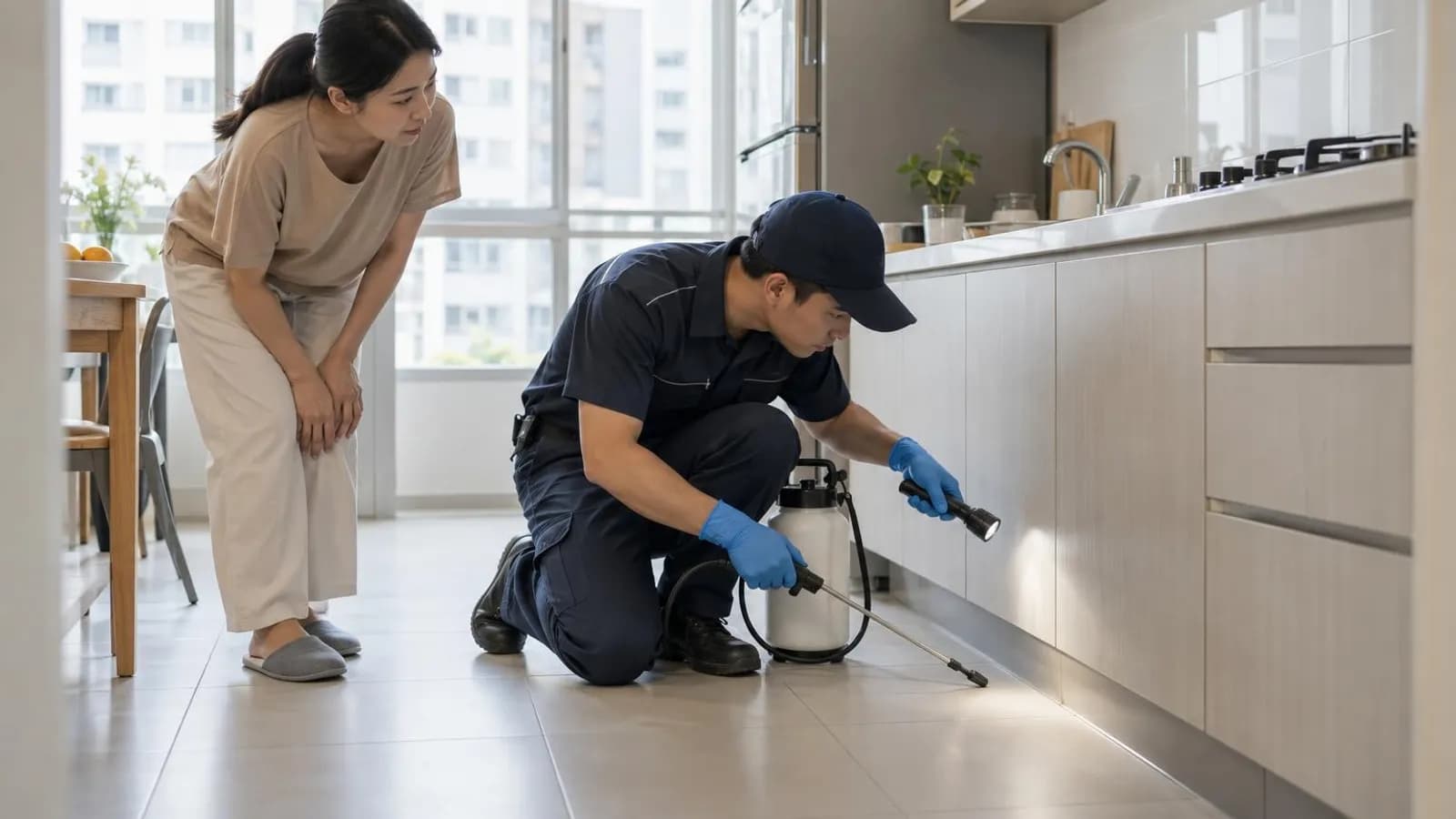 AI image by LocalRank
Pest control is one of the few home services in Singapore where you can check, before you pay anyone, whether the company is allowed to do the work at all. It is a licensed trade, and the regulator publishes the list. This guide covers what that licence does and does not tell you, and what to ask about the things it does not.
Check the register first
Only a company registered with the National Environment Agency as a Vector Control Operator may lawfully provide vector control services in Singapore. NEA publishes the register as a downloadable list from its Vector Control Operator page, and the version we used for this corpus is dated 31 August 2026 and contains 425 operators.
To register, NEA requires a company to be registered with ACRA, to employ at least one dedicated Vector Control Technician with a minimum of three years of vector control experience, and to pay a registration fee. That is what the licence proves.
The register lists each operator with its UEN and its VCO registration number. If a company publishes its UEN on its own website, you can match the two in about a minute. Most do not, which is why it is worth noting when one does.
Check the website actually belongs to the company
This is not a theoretical risk. While researching this corpus we found a company still on NEA’s register whose long-standing domain now redirects to an unrelated foreign site. The company is real and registered; the domain is no longer serving it. Anyone searching for the company by name could land somewhere that has nothing to do with it.
The cheap check: does the address or telephone number on the website match what the register holds for that company? Two independent sources agreeing is worth more than either alone.
Expect to ask for a price
Not one of the operators we researched publishes a price or a price range for pest control work. Quotation on enquiry is the norm in this market, not a quirk of any one company, so there is no published figure to compare against and no "typical price" we can honestly give you.
That makes the questions you ask on the phone the only pricing information you will get. Ask for them in writing.
- What exactly does the quoted figure cover — one visit, or a treatment programme?
- How many visits are included, and over what period?
- Is a follow-up visit included if the problem persists, or charged separately?
- Is there an inspection or call-out fee, and is it deducted if you proceed?
- Is GST included in the figure quoted?
- What happens if the treatment does not work — and is that commitment written down?
Match the company to your actual pest
Companies differ more in what they name than in what they claim. Some list a dozen pests individually; others describe "general pest control" and leave you to ask. If your problem is specific — termites in a timber floor, bed bugs in a mattress, a snake in a garden, stored product insects in a warehouse — look for the company that names it.
Termites are the clearest case. Treatment methods are genuinely different from one another: soil treatment, baiting systems and physical barriers are distinct approaches with different costs and different disruption. A company that names its method has told you something; one that says "termite control" has not.
Ask about chemicals plainly
If you have children, pets, fish tanks or someone in the household with a respiratory condition, say so before the quote rather than on the day. Ask what will be applied, where, how long the area must be vacated, and what the company advises afterwards.
Treat marketing language carefully here. Terms like "eco-friendly", "pet-safe" and "child-safe" are used widely and are not regulated descriptions. They are a reason to ask a more specific question, not an answer to one.
Before you call, have this ready
- Which pest you think it is, and what you have actually seen — droppings, damage, bites, the insect itself
- How long it has been going on, and whether it is getting worse
- Property type and rough size: HDB flat, condominium, landed house, shop, warehouse
- Where the activity is concentrated — kitchen, ceiling, skirting, garden, a specific room
- Whether anyone has treated it already, including supermarket products
- Any children, pets or health conditions in the household
- Whether you rent, in which case your landlord or MCST may need to agree first
Signs worth a second thought
- A quote given over the phone for a problem nobody has looked at
- Reluctance to put the scope, the number of visits or the follow-up terms in writing
- A guarantee of permanent eradication, which no treatment can honestly promise
- A company that cannot be matched to the NEA register by name, UEN or registered address
- Pressure to decide immediately, or a discount that expires while you are on the call
- Claims that a government agency endorses or recommends the company — NEA endorses none
Frequently asked
- Does a company need a licence to do pest control in Singapore?
- Yes. Vector control services may only be provided by an operator registered with NEA as a Vector Control Operator. NEA publishes the register of registered operators from its Vector Control Operator page.
- Does being on NEA’s register mean NEA recommends the company?
- No. NEA states that the list is for reference only and is non-exhaustive, and that it neither endorses the companies nor the products and services they offer. Registration establishes eligibility to do the work, not the standard of it.
- What does NEA require before registering an operator?
- NEA requires the company to be registered with ACRA, to employ at least one dedicated Vector Control Technician with at least three years of vector control experience, and to pay a registration fee.
- How much does pest control cost in Singapore?
- We cannot tell you, and we would rather say so than guess. None of the operators we researched publishes a price or a price range, so there is no published figure to compare. Quotation on enquiry is the norm. Ask what the figure covers, how many visits are included, whether follow-ups cost extra and whether GST is included.
- If a company is not in LocalRank’s ranking, is something wrong with it?
- No. We used NEA’s register of 425 operators to establish who is eligible, then researched 12 in depth for this first ranking and included the seven with sufficiently comparable public evidence. Most registered operators were not researched at all. Absence from the ranking says nothing about a company’s work.
. No changes recorded since. .
Founder and Editor
Amir Wahab is the founder and editor of LocalRank, an independent Singapore rankings and local guides publication.
Read next
10 Best Pest Control Services in Singapore
Compare 10 pest control companies for termites, cockroaches, rodents, bedbugs and mosquitoes — what each does, plus how to choose pest control in Singapore.
By Amir Wahab4 min read
6 Best Grease Trap Cleaning Services in Singapore (2026)
Six grease trap cleaning companies in Singapore for restaurants, cafes and food businesses, with what each says it covers and how to request a quote.
By Amir Wahab5 min read
9 Best Demolition and Hacking Contractors in Singapore (2026)
Nine demolition and hacking contractors in Singapore for HDB, condo, landed and shop jobs, with the hacking, dismantling and reinstatement work each lists.
By Amir Wahab7 min read

8 Best Stone Countertop Suppliers in Singapore (2026)
Eight stone countertop suppliers and fabricators in Singapore for quartz, granite, marble and sintered stone kitchen and vanity tops, with how to choose.
By Amir Wahab6 min read