8 Best Secure Data Destruction Services in Singapore (2026)
8 Singapore secure data destruction and IT asset disposal providers for hard drive shredding, degaussing and wiping, each checked on its own website.
- Edited by
- Amir Wahab
- Published
- Reading time
- 6 min read
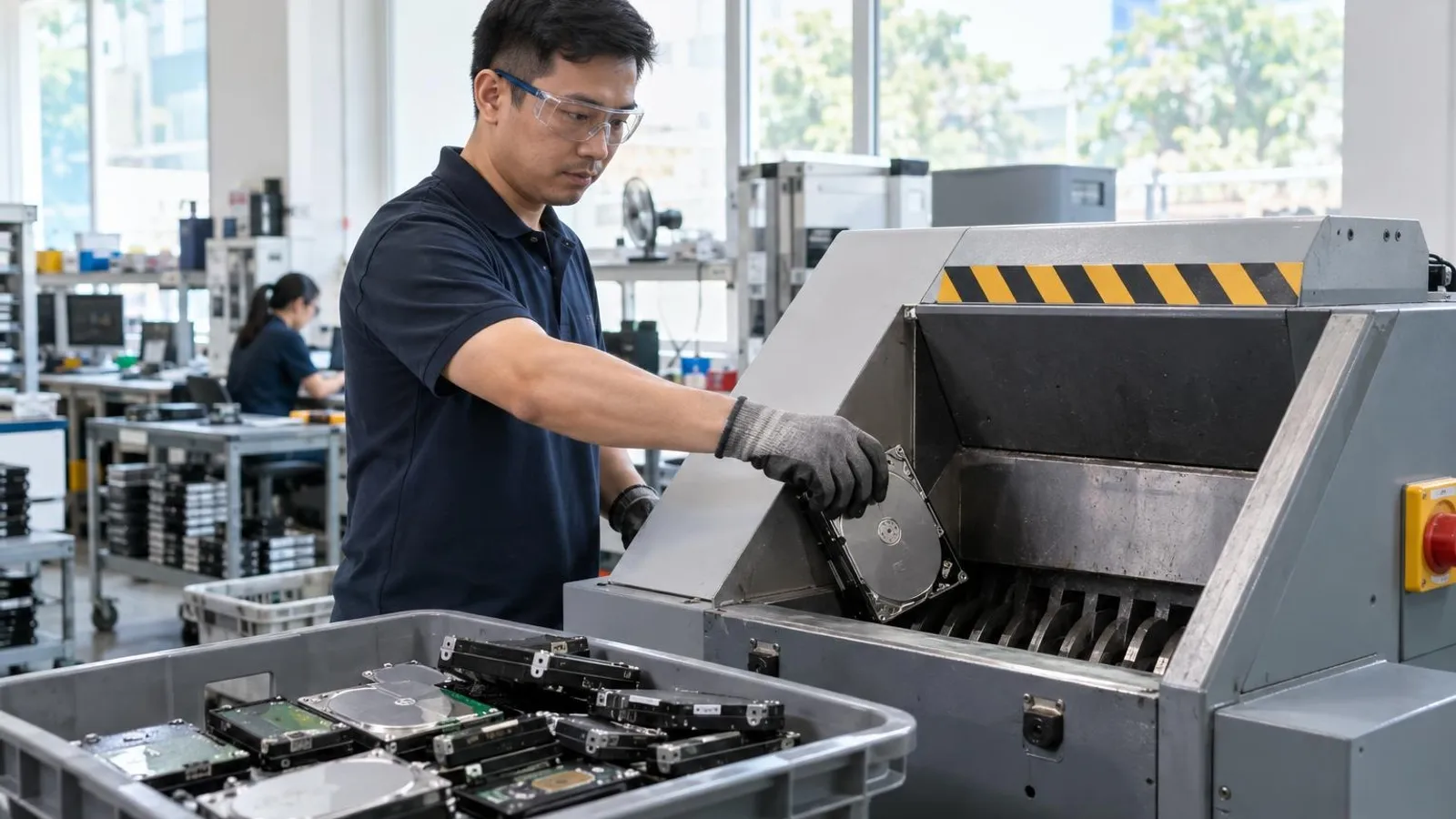 AI image by LocalRank
Deleting files or reformatting a drive does not make the data unrecoverable, which is why old laptops, servers and backup media need proper destruction before they leave your hands. This guide gathers eight Singapore providers that publish secure data destruction or IT asset disposal services, each checked against its own website. They span hard drive shredding and crushing, degaussing, certified software wiping, and on-site or off-site collection with a certificate of destruction. Credentials such as ISO standards and NEA licences are listed only where the provider itself states them. Confirm your device types, volumes, documentation needs and current terms directly with each company before you book a collection.
1. Arkiva
Arkiva is a Singapore destruction specialist whose site covers both individuals and businesses, with separate pages for hard drive destruction, hard disk degaussing, mobile phone and tablet wiping, and wider IT asset disposition. It describes physical destruction for failed drives or highly sensitive data, and NIST 800-88 certified erasure for working drives that will be resold or redeployed. Collection can be ad hoc or recurring, uses GPS-tracked vehicles, and ends with a Certificate of Destruction showing quantity and details. Arkiva's own site lists NEA waste collector and disposal facility licences, ISO 9001, ISO 14001, BizSAFE 3 and i-SIGMA certification. Its document shredding sits under the same roof, which suits offices clearing paper and old IT equipment together.
2. KGS
KGS is a Tuas-based waste and recycling operator whose business arm offers certified data destruction alongside IT asset disposition. Its crushing page describes physically puncturing and deforming the platters or chips in hard disks, SSDs, backup tapes, phones and tablets, with on-site and off-site service and a Certificate of Destruction issued after every job. The company also points customers to a separate degaussing service for magnetic-only erasure and recommends shredding when complete destruction is wanted. KGS says it handles laptops, servers, storage and network devices with a full chain of custody. Its website lists ISO 27001, ISO 9001, ISO 14001 and ISO 45001 certification plus NEA collector and disposal facility licences. That breadth suits larger corporate clear-outs.
3. Crown Information Management Singapore
Crown is the records and information management arm of Crown Worldwide Group, and its Singapore site pairs a records centre with a destruction centre in the Toh Tuck area. For electronic media, its website describes three routes: software data wiping that keeps devices reusable, degaussing followed by shredding, crushing or grinding, and mobile crushing performed at the customer's premises. Degaussing can be done on-site or off-site, and the page says customers may witness the service by video call. A certificate of destruction is described for each service. Crown's page refers to US-DoD and NIST guidelines rather than listing formal accreditations, so ask what documentation and audit trail it will supply. It suits companies already storing records with a larger provider.
Toh Tuck
Visit website ↗View on map ↗
4. Gee Hoe Seng (GHS)
Gee Hoe Seng is a Singapore waste management and recycling company that says it has served commercial and industrial clients since 1992, and its data destruction service sits alongside food waste, paper and metal recycling. The service page describes three methods: software data wiping for drives that may be reused, degaussing for highly sensitive hard drives, and secure shredding of devices and paper. It lists hard drives, SSDs, USB drives, magnetic tapes, mobile devices and laptops as accepted items, with on-site collection from offices and data centres on a one-time, scheduled or recurring basis. A Certificate of Destruction is offered for each completed job on request. The company's site states NEA Class A and B licensing and ISO 9001 and 14001 certification.
5. SAMS (Sustainable Asset Management Solutions)
SAMS is an electronics waste and IT asset disposition company that offers mobile, on-site data destruction as a distinct service. Its site describes a dual-shredding media disintegrator that reduces SSDs, memory cards, USB sticks and NVMe drives to roughly 4mm particles, and a twin-shaft shredder for 3.5-inch and 2.5-inch hard drives and tape drives. Customers can watch the destruction live, and a certificate of destruction is described for every batch. SAMS says its on-site work follows NIST 800-88r1, DIN 66399 and DoD 5220.22-M and meets the NSA/CSS 9-12 policy manual. Its certifications page lists R2v3, including data sanitisation, plus BizSAFE Star. That makes it a strong option when drives must not leave the building.
Penjuru, Jurong
Visit website ↗EmailView on map ↗
6. Vision Green
Vision Green is an e-waste recycler with Tuas and Gul sites that sells data destruction as part of a wider ITAD workflow. Its website describes five steps: secure collection with chain of custody, asset tagging and serial capture at its facility, data sanitisation to NIST 800-88, reuse or parts recovery, and a final data destruction and recycling certificate. It lists hard drive shredding, degaussing and wiping, with on-site or off-site options. For SSDs, the company says its shredding process can handle up to 250 devices an hour and uses GPS-tracked transport in locked, sealed containers. Its pages state R2v3, ISO 9001, ISO 14001, ISO 45001 and BizSAFE Star compliance. It suits businesses wanting serial-numbered reporting for audits.
7. Tech Dynamic (TD ITAD)
Tech Dynamic runs a dedicated ITAD website covering certified IT asset disposal, secure media destruction, an IT asset buyback programme, document shredding and uniform disposal. Its media destruction page describes compliant data sanitisation, physical destruction by shredding, degaussing for magnetic storage and chain-of-custody documentation, while the buyback service says assets are securely wiped before valuation and pickup. A certificate of destruction is described for its document shredding service. The company's site lists an NEA Class A general waste collector licence, ISO 9001, 14001 and 45001, and the SS 587 standard for end-of-life ICT equipment, and its blog was still posting in 2026. Its mix of buyback and destruction suits firms refreshing devices in bulk.
8. BigVoice Secure Destruction
BigVoice Secure is a Woodlands-based destruction company that keeps its offer simple: collect from your location, destroy at its secure facility, then issue a Certificate of Destruction. Its services page lists four methods for electronic items, namely industrial shredding, crushing that breaks hard drives in half, degaussing, and drilling holes through the drive. For degaussing, the company says it uses a Verity Systems SV91m unit that it states meets NATO and NSA requirements. Items it accepts include hard drives, backup tapes, laptops, mobile devices, IT equipment and confidential documents, and it also lists a buyback page. The site does not publish a list of ISO or NEA credentials, so ask for its documentation. It suits smaller firms wanting a straightforward service.
How to choose
- Match the method to the media and your plans for the hardware. Software wiping or certified erasure keeps working drives resalable, degaussing suits magnetic hard drives, and shredding or crushing is the safer route for failed drives, SSDs and anything highly sensitive. Ask each provider which method it recommends for your device mix.
- Decide between on-site and off-site service. On-site shredding lets your staff witness destruction and removes transport risk, while off-site processing at a secured facility is usually simpler for large volumes. If drives travel, ask about sealed containers, tracked vehicles, serial-number logging and written chain-of-custody records.
- Ask what paperwork you receive. A certificate of destruction should identify the batch, quantity and method, and ideally serial numbers, because auditors and the PDPC may want evidence that data-bearing media was handled properly. Request a sample certificate and ask whether it is issued automatically or only on request.
- Check credentials directly rather than relying on marketing lines. ISO standards, NEA waste collector or disposal facility licences, and schemes such as R2v3 are published by several providers here, but not all. Ask for current certificates, confirm the scope covers data destruction, and note that some providers cite guidelines instead of accreditation.
- Separate destruction from asset recovery. Buyback and refurbishment programmes can offset costs on newer equipment, but they need verified wiping first and clear reporting on what was sold or recycled. For old or damaged drives, request a written quote for destruction only, and compare per-item and per-collection terms.
. No changes recorded since.
Founder and Editor
Amir Wahab is the founder and editor of LocalRank, an independent Singapore rankings and local guides publication.
Read next

6 Best Zoho Partners in Singapore (2026)
Six Zoho partners serving Singapore SMEs for CRM, Books and Creator set-up, customisation, migration and support, with what each lists and how to choose.
By Amir Wahab5 min read

6 Best Salesforce Consultants in Singapore (2026)
Compare 6 Salesforce consultants and implementation partners in Singapore, from SME specialists to enterprise integrators, with what each says it offers.
By Amir Wahab5 min read

7 Best RFID Solution Providers in Singapore (2026)
Compare 7 RFID solution providers in Singapore for inventory tagging, asset tracking and access, with what each says it supplies and how to choose one.
By Amir Wahab6 min read

6 Best Odoo Implementation Partners in Singapore (2026)
Compare six Odoo implementation partners in Singapore for SMEs, with notes on modules, InvoiceNow support, grants and how to choose the right ERP team.
By Amir Wahab5 min read