8 Best POS Systems in Singapore (2026)
Compare 8 POS systems in Singapore for cafes, restaurants and retail shops, from F&B specialists to omnichannel platforms. Find the right fit for you.
- Edited by
- Amir Wahab
- Published
- Reading time
- 6 min read
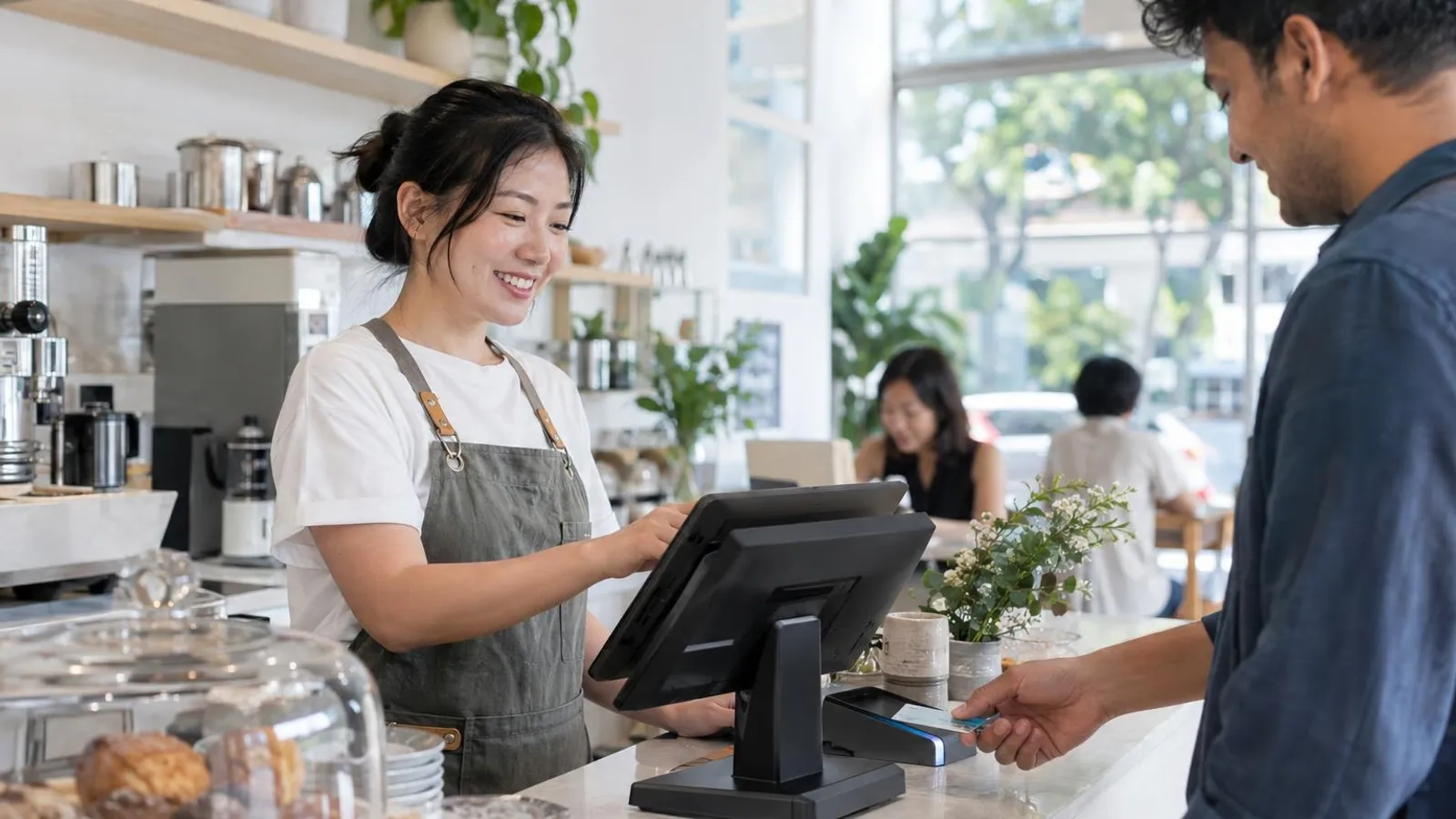 AI image by LocalRank
Choosing a point-of-sale system is one of the first technology decisions a Singapore cafe, restaurant or shop has to make, and it is rarely easy to undo. The right system shapes how fast you take orders, how clean your stock counts are and how well you can sell across dine-in, delivery and online. This list covers eight providers with a clear Singapore offering, mixing F&B specialists, retail-friendly platforms and local vendors. Each write-up is based on what the provider says on its own website, so confirm features, hardware and fees directly with a vendor before signing anything. We have deliberately left out pricing, because plans change often.
1. Eats365
Eats365 builds restaurant-focused point-of-sale software and runs a dedicated Singapore site with local sales and support contacts. Its site describes a modular approach, listing a core POS plus add-ons such as online ordering, scan-to-order, self-service kiosks, kitchen display screens, queue management and multi-outlet management. It also offers its own payment option, called 365pay. The company says it serves quick-service restaurants, cafes, bars, food courts, cloud kitchens and all-you-can-eat concepts, and the Singapore page carries a testimonial from a local chicken rice business. Because the system is split into functions, it can suit operators who want to add capabilities as they grow. It also advertises a free trial period and a complimentary demo session for new enquiries.
2. Qashier
Qashier is a POS and payments platform aimed at small businesses, with a Singapore-facing site that covers F&B, retail and beauty or service businesses. Its homepage says it can bring walk-in, GrabFood, foodpanda and Shopee orders into one screen, and sync with Shopify and WooCommerce stores. It lists support for cards, PayNow and e-wallets, plus a loyalty feature to bring customers back. The company says it serves more than 25,000 merchants across Singapore, Malaysia, Thailand and the Philippines, and describes itself as licensed by the Monetary Authority of Singapore. That claim is the company's own, so verify it if payments compliance matters to you. It looks most relevant to owner-operators wanting an all-in-one setup without a heavy implementation.
3. FeedMe
FeedMe is a restaurant technology company that lists a Singapore office, FeedMe Pte. Ltd., alongside operations in Malaysia and Thailand, and publishes a Singapore contact number on its site. Its ecosystem is built around a POS, with separate modules for marketing and loyalty, inventory, reporting, human resource management and integrated payments. The company says its payments can accept debit and credit cards, e-wallets and Apple Pay, and it promotes an AI assistant called REMY for sales insights. It states it is trusted by more than 10,000 merchants across its markets, though that figure is not specific to Singapore. FeedMe may suit restaurant groups that expect to manage several outlets, a central kitchen or supplier stock from a single back office.
4. Aptsys
Aptsys is a Singapore-based vendor that describes itself as a complete F&B platform and gives its address at Link@AMK in Ang Mo Kio. Its site lists Jade, its next-generation POS, alongside a loyalty and CRM module with points, tiers and stored value, QR ordering with payment, a self-service kiosk and a WhatsApp-based reservation tool called Bookwise. Recent homepage copy also highlights AI features, such as automated daily revenue summaries and win-back vouchers for lapsed customers, which are the company's own descriptions. The site links to a government pre-approved vendor page, so operators interested in digitalisation grants can ask Aptsys directly which of its solutions are covered and what the current conditions are.
Ang Mo Kio
Visit website ↗EmailView on map ↗
5. MEGAPOS
MEGAPOS is a Singapore POS vendor whose site covers restaurants, cafes and food kiosks, salons and spas, and retail. Its F&B range includes QR ordering, self-ordering kiosks, a combined POS and kiosk device, a CRM membership app, kitchen management, inventory linking and number calling. The site also describes integrated PayNow and card payments, and says orders from GrabFood can flow into kitchen printers or screens alongside in-house orders. A testimonial on the homepage from a dim sum restaurant says it has used MEGAPOS for ten years. The site has a page on available grants, which is worth raising when you request a quote. MEGAPOS looks like a practical choice for operators who want a local vendor with several ordering options.
6. EPOS
EPOS Pte. Ltd. is a Singapore POS and payments company whose site covers retail, food and beverage, and minimart systems. It describes a cloud-based platform that syncs sales and inventory data to a back end, can be accessed through a web browser and keeps working offline. The company also promotes real-time reporting, e-commerce integration, a rewards product and a support line it calls 24/7. It describes itself as Singapore's leading POS provider and cites a 2020 independent survey, and states that it is an approved vendor under the IMDA SMEs Go Digital programme and the Climate Voucher scheme. Treat those as the company's own claims. Its listed office is at Thye Hong Centre along Leng Kee Road.
7. Raptor POS
Raptor POS is a hospitality-focused system from Raptor POS Pte Ltd, which gives a Singapore office at Midview City in Sin Ming. Its site says the company launched in 2001, is headquartered in Singapore and has offices in Malaysia, Indonesia and the Philippines. The product line covers a touch-screen POS designed to minimise screen taps, a kitchen display system, and a back office with security, promotions, customer relations and reporting. A news item on its homepage describes a partnership with Adyen aimed at Singapore service businesses. The company describes itself as a leading hospitality systems provider, which is its own claim. It tends to suit bars, restaurants and quick-service outlets that want a configurable system with kitchen-side screens.
8. Shopify POS
Shopify POS is the in-person selling tool from Shopify, which runs a Singapore version of its site. Unlike the F&B specialists above, it is aimed at retailers, and Shopify's page presents it for single stores, multiple stores and pop-up or market selling. The company says it keeps in-store and online orders in sync, with one back office for inventory across locations, staff permissions, customer profiles and reporting. It lists hardware for the counter or for mobile selling, and says merchants can use Shopify Payments. If you already run, or plan to run, an online shop on Shopify, the shared catalogue may save duplicated work. It is less suited to table-service restaurants that need kitchen display screens or table management.
How to choose
- Start with the business model. A restaurant needs table management, kitchen printing or screens and modifiers on menu items, while a shop needs barcode scanning, variants and stock transfers. Providers on this list lean towards one side or the other, so match the vendor's stated focus to how you actually sell before comparing features.
- Ask how orders from GrabFood, foodpanda, your own website and QR ordering reach the kitchen. Several vendors here say they merge channels into one screen, but integrations differ by provider and can change. Request a live demonstration using your own menu rather than relying on a feature list or a brochure.
- Understand the full cost structure instead of the headline. Ask about hardware purchase or rental, monthly software fees, payment processing rates, onboarding, support hours and what happens to your sales data if you leave. Get every item in writing, and compare quotes for the same number of terminals and outlets.
- Check grant eligibility directly. Some vendors here mention government digitalisation schemes, but eligibility, funding levels and approved solutions change over time. Confirm the current conditions with the vendor and the relevant agency before you commit, and do not assume a scheme covers every module, device or payment feature.
- Test support and reliability before buying. Ask whether the system keeps taking orders when your internet drops, how fast the vendor responds during peak dinner hours and whether help is available on weekends. Speak to a few existing customers in your trade, because a smooth demo does not guarantee dependable service.
. No changes recorded since.
Founder and Editor
Amir Wahab is the founder and editor of LocalRank, an independent Singapore rankings and local guides publication.
Read next

8 Best Loyalty Programme Platforms in Singapore (2026)
Compare loyalty programme platforms in Singapore for retailers and F&B: digital stamps, points, vouchers and tiers, with what each provider says it offers.
By Amir Wahab6 min read

5 Best Home Tech Support Services in Singapore (2026)
Five Singapore services that send a technician to your home for computer, wifi, printer and device help, plus how to choose one for family or seniors.
By Amir Wahab4 min read

8 Best WordPress Developers in Singapore (2026)
Compare 8 Singapore WordPress developers and studios that build, migrate and maintain WordPress and WooCommerce sites for local SMEs in 2026.
By Amir Wahab6 min read

8 Best Chatbot and AI Assistant Developers in Singapore (2026)
Compare 8 chatbot and AI assistant developers in Singapore that build customer-service bots, WhatsApp assistants and custom AI agents for local businesses.
By Amir Wahab6 min read