6 Best Hairdressing Courses in Singapore (2026)
Where to learn hairdressing in Singapore: private hair schools, a salon-group training route, ITE's full-time course and short cutting classes compared.
- Edited by
- Amir Wahab
- Published
- Reading time
- 5 min read
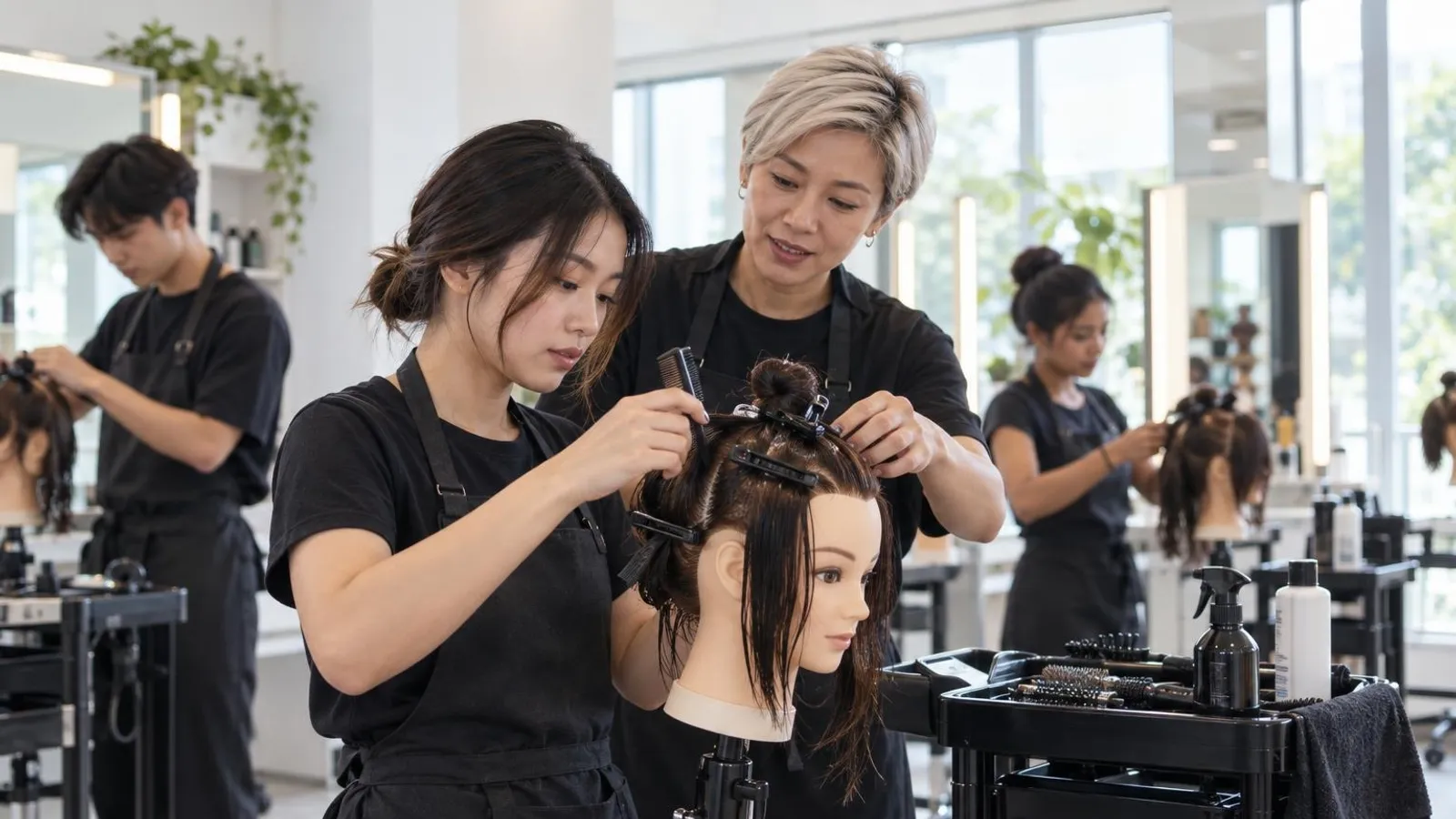 AI image by LocalRank
Learning to cut, colour and style hair in Singapore can mean a multi-month school programme, a salon-group training route or a two-session weekend class, and the providers here sit across that whole range. This guide covers six that publish their hairdressing courses on their own pages, from a private hair school and a Korean-led academy to the government institute that teaches the trade full time. We describe each only as it presents itself and leave out fees, because they and the funding rules change. Decide how much time you can commit, then confirm current intakes with the provider. For help with hair rather than lessons, see our guide to hair salons.
1. Kimage Hairdressing School
Kimage Hairdressing School splits its catalogue into full courses and short courses. Its Certificate in Foundation Hairdressing is written for people with no prior training and centres on three modules: shampoo and blow styling, perming and colouring, with mannequin sessions before live-model practice. The Diploma in Comprehensive Hairdressing is described as the follow-on, strengthening cutting, perming and colouring at a more advanced level. Shorter options listed on the site include men's and ladies' haircutting courses, a barbering module, shampoo and blow, and a one-day colour and cut class. The school says its foundation and diploma programmes are eligible for UTAP funding. It suits beginners wanting a structured route. Check current intakes with the school.
Marina Square
Visit website ↗View on map ↗
2. nVisually Academy
nVisually Academy is the training arm of a Korean-style salon group and says it serves beginners and continuing learners. Its site lists a Certificate in Fundamental Hairdressing, with perming, colouring and basic cutting as separate modules, and a Diploma in Professional Hairdressing aimed at learners who already have some hairdressing experience, covering advanced cutting, colouring and perming. The diploma page describes classroom teaching with full-time and part-time schedules and sets minimum age and language requirements. A Diploma in Salon Management is presented as a blended course run in partnership with another institute, while short courses include Korean head spa and salon procedures. A Korean hair workshop is marked as coming soon. Contact the academy for intake dates.
3. Jean Yip Academy
Jean Yip Academy is the training route run by the Jean Yip salon group, and learning is tied to a job. The group's academy page invites aspiring hairstylists and beauticians to join its Certificate of Competency training programme, which it describes as in-class learning combined with hands-on on-the-job training, leading to a Certificate of Competency issued by the Institute of Technical Education. The page says applicants must be Singapore citizens or permanent residents aged 18 to 50, with male applicants having completed National Service, and notes that the programme is SkillsFuture claimable. A separate Earn As You Learn page presents paid trainee roles. It suits career changers wanting a salon pathway. Enquire about current intakes.
Kaki Bukit
Visit website ↗WhatsApp ↗View on map ↗
4. ITE College East (Higher Nitec in Hairdressing & Salon Management)
The Institute of Technical Education lists its Higher Nitec in Hairdressing & Salon Management as a full-time course at ITE College East, with a stated duration of 24 months. The course finder says learners study salon operations, shampoo and head massage, haircuts and styling, perming and rebonding, colouring, hair and scalp treatments, client consultation and basic makeup and internships. Entry is described as GCE O-Level results in English and two other subjects, including Mathematics, or a qualifying Nitec grade point average, and students must buy a laptop. The page also lists progression routes to further diplomas. This is the longest and most formal route here, aimed mainly at school leavers and Nitec graduates. Check intakes with ITE.
5. SACE
SACE is an adult-learning association, and one of its listed short courses is Hair Cutting & Styling. The course page lists a seven-hour class over two Tuesday afternoons in November 2026 at Excelsior Shopping Centre. Its stated objectives include learning to handle scissors and comb, understanding different hair textures and cutting a basic hairstyle, through a demonstration followed by practice on live models. The page gives a trainer profile citing a hairdressing diploma and a long career in the trade, and says SkillsFuture Credit applies. This is a light introduction rather than a qualification, suited to hobbyists and the curious. Confirm the next intake and registration steps directly with the SACE secretariat.
Excelsior Shopping Centre, City Hall
Visit website ↗View on map ↗
6. People's Association (SkillsFuture@PA Unisex Hair Cutting Course)
The People's Association lists community-club classes through its onePA portal, including a Unisex Hair Cutting Course taught in modules. The Module 2 listing, organised by Nee Soon East Community Club, runs four morning sessions from 6 to 14 December 2026 and says it is conducted in English and Mandarin. Its description promises haircutting techniques plus styling tips so that learners can achieve the look they want for themselves or others without visiting a salon. A Module 1 class is shown alongside it, and the listing notes some tools are optional extras bought from the trainer. This is a neighbourhood-level hobby class rather than a career course. Check onePA for the venue and dates closest to you.
Community clubs islandwide (listed example: Nee Soon East)
Visit website ↗View on map ↗
How to choose
- Start with your goal. A full-time diploma or a salon-group training route suits someone aiming to work as a stylist, while a two-session class suits a hobbyist or parent who wants basic cutting skills. Ask each provider what a learner can realistically do at the end and whether the course expects any prior experience.
- Look at how practice is organised. Providers here describe mannequin work, live models, on-the-job training or demonstrations, and the mix varies a lot between a school and a community class. Ask how many practice sessions each learner gets, how many people share a trainer, and whether you must source your own models.
- Check the entry requirements before you fall in love with a course. Several providers publish minimum ages, language levels, citizenship conditions or prior-experience rules, and some advanced programmes assume you already hold a basic qualification. Read the admission page carefully, then email to confirm that your background fits before paying anything.
- Ask about funding in writing. Providers mention schemes such as SkillsFuture Credit or union training support, but eligibility, claim windows and the amounts covered change. Request the current course reference and ask what you must pay upfront, which items such as toolkits are extra, and what the refund and deferment rules are.
- Treat any qualification wording as the provider's own statement. If a course mentions a Certificate of Competency, a diploma or a partner institute, ask who issues it, what it lets you do afterwards and where you can verify it. Then ask for the current intake date, because many schedules open only a few times a year.
. No changes recorded since.
Founder and Editor
Amir Wahab is the founder and editor of LocalRank, an independent Singapore rankings and local guides publication.
Read next

6 Best Motorcycle Rental Companies in Singapore (2026)
Compare 6 motorcycle and scooter rental companies in Singapore, from Class 2B hire to long-term leasing, with what each says it offers and how to enquire.
By Amir Wahab5 min read

7 Best Invisible Grille and Safety Netting Installers in Singapore (2026)
Compare 7 invisible grille, cat mesh and safety netting installers in Singapore for HDB, condo and landed homes, with what each company says it offers.
By Amir Wahab5 min read

7 Best Roller Shutter and Industrial Door Suppliers in Singapore (2026)
Seven roller shutter and industrial door suppliers in Singapore, from shopfront and fire-rated shutters to high-speed and sectional doors, plus tips.
By Amir Wahab5 min read

6 Best Car Upholstery and Seat Cover Specialists in Singapore (2026)
Six Singapore workshops for car leather seats, re-trimming, roof lining and interior trim, with what each says it offers and how to choose well.
By Amir Wahab5 min read