How to Choose an Electrician in Singapore
Who may legally do electrical work, the two things you may lawfully do yourself, how to check a licence, and why the prices will not line up.
- Edited by
- Amir Wahab
- Published
- Last reviewed
- Reading time
- 8 min read
AI disclosure. AI tools were used to help draft this guide. Research and drafting were AI-assisted. Every factual claim was checked against the Electricity Act 2001, EMA publications, a government register, or the named company website, and the named editor is accountable for accuracy regardless. How we use AI.
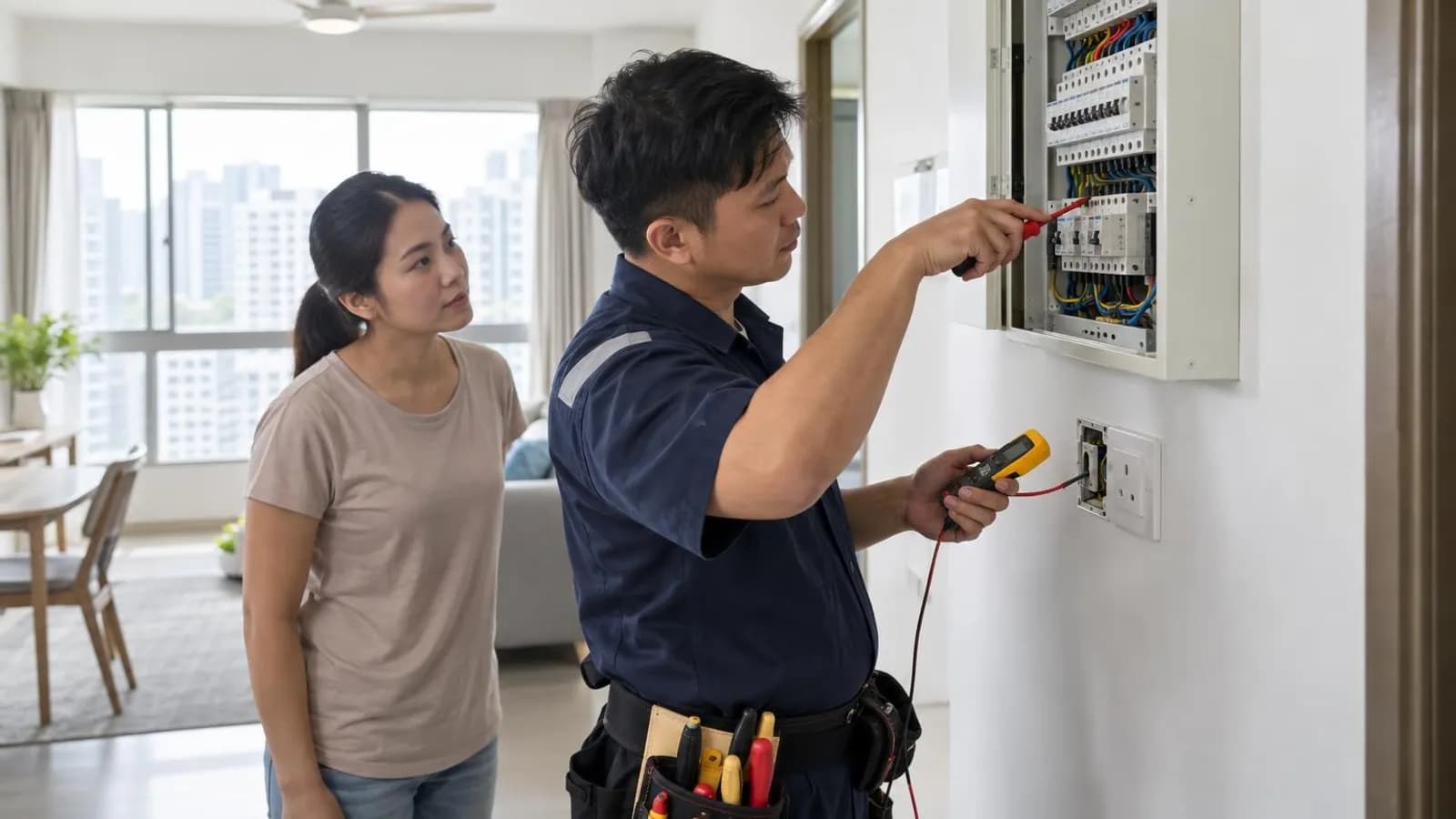 AI image by LocalRank
Most household trades leave it to you to decide how careful to be. Electrical work does not: Singapore law sets out who may do it, and puts an obligation on the person hiring as well as the person working. Knowing the shape of that is most of what you need to choose well.
The licence belongs to a person, not a company
EMA licenses individual Licensed Electrical Workers in three classes — Electrician, Electrical Technician and Electrical Engineer — distinguished by the size of installation they may work on. EMA states that electrical work in an HDB flat requires an electrician, while larger installations such as a food court need a technician or an engineer.
What the law requires of the firm — and of you
Section 82 of the Electricity Act 2001 sets out four things worth knowing. An individual must not carry out electrical work unless they are a licensed electrical worker or are working under the supervision of one. A business must not provide electrical work unless it ensures the work is carried out by, or supervised by, licensed electrical workers. A business must not hold itself out as authorised unless it does that. And an owner or occupier must not knowingly engage a person who is not permitted to carry out the work. Contravening any of these is an offence.
The practical consequence is that asking who the licensed worker is on your job is not an awkward question. It is the question the statute is built around, and a company providing electrical work should have a ready answer.
What you may lawfully do yourself: very little
The Act lists narrow exceptions. A person may replace a lamp connected in their own electrical installation, and may replace a fuse in their own installation similar to that of a household. There are further exceptions for EMA’s own officers, for a tradesperson working on an appliance provided they do not work on any part or circuit connected to a supply of electricity, and for a trained person working to the written instructions of the licensed electrical worker in charge.
How to check a licence
Every Licensed Electrical Worker is issued a licence card carrying a photograph, their name, identity card number and licence number. EMA advises verifying the card before any electrical work begins.
You can also search EMA’s e-Licence Information Services portal, ELISE, under "Search for Licensed Workers" and then "Electrical worker who offers services to consumers". It needs no account, and you can search by name, by licence number, by postal code or by street. Searching by the licence number exactly as it appears on the card is the most reliable. You will be asked to type a short security code before each search.
What an installation licence is, and why your home does not need one
A separate EMA scheme licenses electrical installations — for non-domestic premises above 45kVA, for hazardous trades, and for certain supply installations. That licence is held by the owner or user of the installation, not by the contractor, and EMA states that the scheme does not apply to installations used exclusively for residential purposes. If a company mentions an installation licence, it is not telling you anything about your flat.
Why the prices are so hard to compare
Electricians publish more pricing than plumbers do, which sounds like good news until you try to put two of them side by side. Among the companies we researched, one publishes per-item prices stated as inclusive of labour and transport. Another publishes a base service charge, a separate transport fee, and per-service rates on top. A third publishes a minimum charge, a fuel surcharge, an urgency fee and price ranges, plus out-of-hours percentages by time of night. A fourth publishes a transport fare and a labour-only rate.
All four are honest. None of them can be compared with the others as a single "from" figure, which is why this comparison does not try. Worth knowing too: of the companies we researched, not one published its prices together with a statement about GST.
What to ask before anyone starts
- Who is the Licensed Electrical Worker responsible for this job, and what is their licence number?
- Is there a call-out, transport or minimum charge, and does it apply if I decide not to go ahead?
- Is the price quoted for labour only, or does it include materials?
- Is that price with or without GST?
- Is there a surcharge for evenings, nights, weekends or public holidays?
- What is the warranty, how long does it run, and does it cover the work as well as the parts?
- If the same fault comes back, is the return visit charged?
Warranties are shorter and vaguer than you would expect
Among the companies we researched, published terms ranged from a year on workmanship and supplied parts with the exclusions written down, to three months on parts only, to a workmanship warranty whose duration "varies by job type", to a warranty asserted with no duration or coverage at all. Several published nothing. One company’s own FAQ asks whether it provides a warranty and publishes no answer. "Warranty provided" on its own tells you very little.
Frequently asked
- Do I need a licensed electrician for work in my HDB flat?
- For most electrical work, yes. EMA states that installing, repairing or modifying electrical wiring, adding, extending or replacing power points, socket-outlets, switches or lighting points, and repairing or replacing consumer control units or circuit breakers should be carried out or supervised by a Licensed Electrical Worker, and that work in an HDB flat requires an electrician. The Electricity Act allows a person to replace a lamp, and to replace a fuse in their own installation similar to that of a household, without a licence.
- Is an electrical company itself EMA licensed?
- No. EMA licenses individual electrical workers in three classes; a company cannot hold a worker licence. What the law requires of a business is different: under section 82 of the Electricity Act it must ensure that the work it provides is carried out by, or supervised by, licensed electrical workers. So the useful question is which licensed worker is responsible for your job.
- Can I get in trouble for hiring the wrong person?
- The Electricity Act states that an owner or occupier who wishes to have electrical work carried out at their premises must not knowingly engage a person who is not permitted to carry it out, and that contravening this is an offence. That is why asking about the licensed worker is worth doing, and why a company that cannot answer is telling you something.
- How do I check that someone is a Licensed Electrical Worker?
- Every Licensed Electrical Worker carries a licence card with their photograph, name, identity card number and licence number, and EMA advises verifying the card before work begins. You can also search EMA’s ELISE portal under "Search for Licensed Workers", choosing "Electrical worker who offers services to consumers". Searching by the licence number exactly as printed on the card is the most reliable.
- Did LocalRank verify the licence numbers these companies publish?
- No. Two of the companies compared here publish a specific licence number, and we report both as the companies’ own statements rather than as confirmed licences. We have not checked them against EMA’s records. That is not a suggestion that either number is wrong — it means the check is one you can make yourself, and the guide explains how.
- How much does an electrician cost in Singapore?
- There is no comparable figure. Of the twelve companies we researched in September 2026, five published prices, in four structures that do not line up: per-item prices inclusive of transport; a base charge plus a transport fee plus per-service rates; a minimum charge with fuel and urgency surcharges, price ranges and out-of-hours percentages; and a transport fare with a separate labour-only rate. Not one published prices together with GST treatment. The figures that exist appear in the individual entries above, with their limitations.
- Did LocalRank test any of these electricians?
- No. We have not used any of these companies, called them, requested a quote, or watched a job. This comparison is based on what each company publishes, plus government register records where they exist. It compares published evidence, not workmanship.
. No changes recorded since. .
Founder and Editor
Amir Wahab is the founder and editor of LocalRank, an independent Singapore rankings and local guides publication.
Read next
8 Best Ventilation and Exhaust Fan Installers in Singapore (2026)
Find 8 ventilation and exhaust fan installers in Singapore, from toilet fan fitting to kitchen exhaust and ducting, with tips on how to request a quote.
By Amir Wahab6 min read
10 Best Electricians in Singapore
Compare 10 electrical companies for hiring an electrician in Singapore, covering power trips, rewiring, DB box work and light or fan installation.
By Amir Wahab4 min read

6 Best Grease Trap Cleaning Services in Singapore (2026)
Six grease trap cleaning companies in Singapore for restaurants, cafes and food businesses, with what each says it covers and how to request a quote.
By Amir Wahab5 min read

9 Best Demolition and Hacking Contractors in Singapore (2026)
Nine demolition and hacking contractors in Singapore for HDB, condo, landed and shop jobs, with the hacking, dismantling and reinstatement work each lists.
By Amir Wahab7 min read