7 Best Woodworking Classes in Singapore (2026)
Compare 7 woodworking classes and studios in Singapore, from beginner hand-tool workshops to multi-week furniture courses and joinery specialists.
- Edited by
- Amir Wahab
- Published
- Reading time
- 6 min read
 AI image by LocalRank
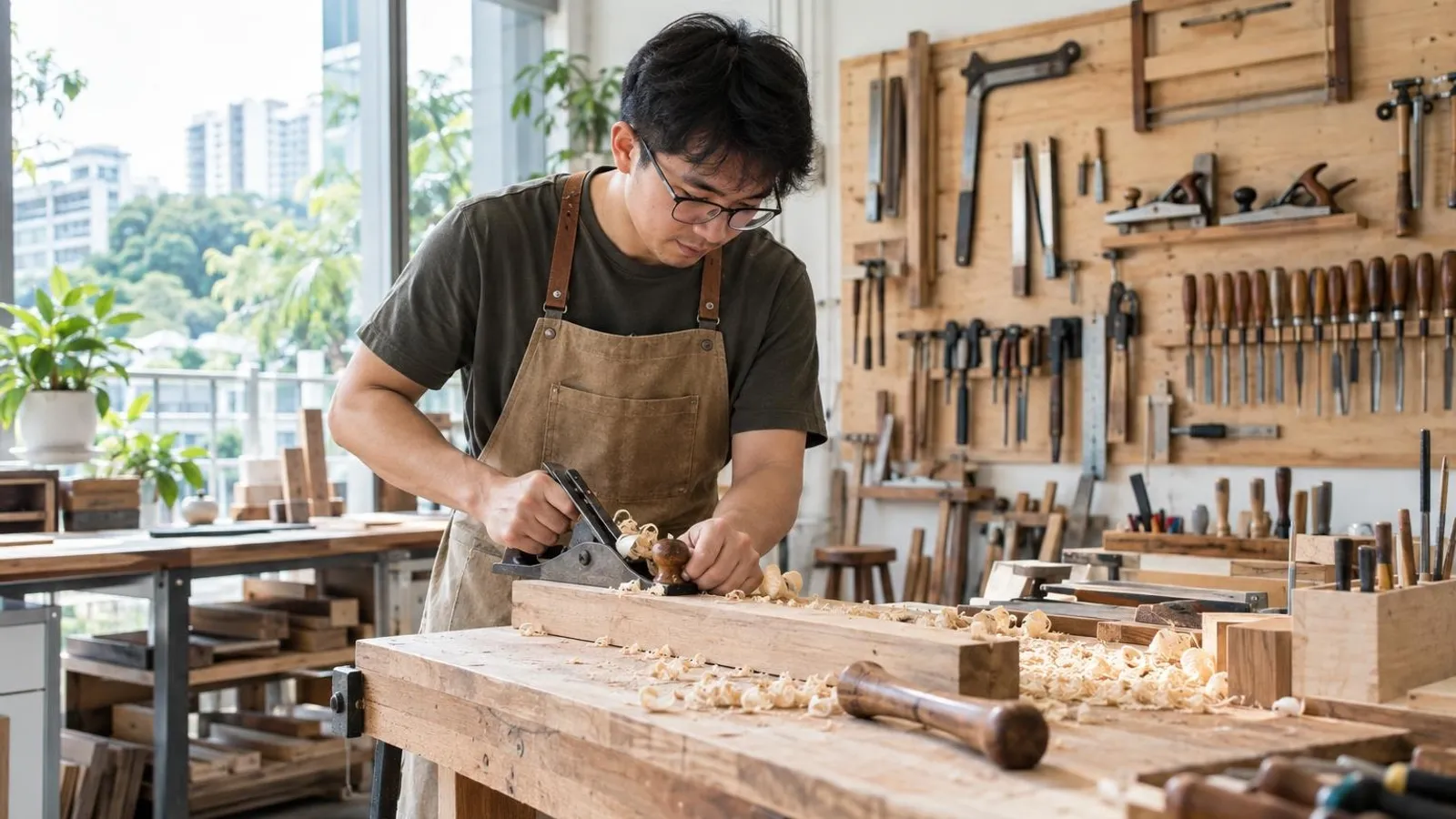
Singapore's woodworking scene runs from single-afternoon beginner workshops to multi-week furniture-making courses, plus a few studios built around kids learning real hand tools. This guide covers studios that teach the craft yourself — cutting, carving, joining and finishing wood — rather than carpentry contractors who build cabinetry, or the pottery and ceramics studios covered elsewhere on this site. Each entry notes what the studio specialises in, since some focus on quick beginner projects, others on structured furniture courses or a specific joinery tradition, and a couple split their space across other crafts too. Checked against each studio's own site or verified listings, treat this as a shortlist to compare rather than a strict ranking.
1. Roger&Sons
Roger&Sons traces back to 1999, when it started as JR&P Industries, an office furniture manufacturer founded by Roger; his three sons rebranded the business after he was diagnosed with cancer in 2014, shifting it toward bespoke furniture, product design and woodworking. Its public workshops target complete beginners, and the studio says it aims for a "relaxed, non-intimidating and positive environment" where participants build a household item or small furniture piece while picking up real technique. It also runs corporate team-building workshops and rents its showroom floor for events. A distinguishing thread is its Local Tree Project, through which it says it salvages trees felled for urban development into furniture, tying its classes to a wider sustainability practice rather than a standalone add-on.
Kallang
Visit website ↗View on map ↗
2. The Common Bench
The Common Bench runs a beginner-focused Basic Woodworking for Adults workshop from its Novena studio, a single afternoon session that its site says takes newcomers from planning and marking out through sawing, assembly and finishing, with tools and materials supplied. It frames woodworking as a life skill as much as a craft, and pairs the adult class with a Family Wood Construction session so parents and children can build alongside each other. Woodworking sits within a broader maker-education business that also teaches ceramics and runs school STEAM consultancy and holiday camps, so the studio is not exclusively wood-focused, though its woodworking class is a distinct, structured offering. It also takes private group bookings for occasions such as birthdays or team outings.
3. Ugly Wood Company
Ugly Wood Company operates an appointment-only workshop on Canberra Street and keeps a four-to-one student-to-teacher ratio, stating this lets each participant get close guidance rather than get lost in a larger group. Its programme spans beginner through advanced work, with newcomers typically starting on compact projects such as a serving board or side table before moving into more involved furniture pieces, and it also builds fully customised sessions for individuals or groups. The studio positions itself at people with no prior background, describing its purpose as helping someone "with zero experience in the craft" take a first real step into woodworking rather than a one-off novelty session. Because bookings are appointment-based rather than walk-in, class sizes and scheduling flex around who has signed up.
Sembawang
Visit website ↗View on map ↗
4. Tombalek Workshop
Tombalek Workshop runs from a large, multi-craft studio on Mandai Link that its site says spans more than 7,000 square feet, teaching woodworking alongside metalworking, glassblowing and blacksmithing under one roof. Its woodworking side is built around structured, multi-week furniture courses rather than single sessions: students progress through joinery-focused builds such as an armchair joined with rabbets instead of nails or screws, a spindle table that introduces lathe leg-turning, and a mortise-and-tenon chair finished with upholstery. Courses run as weekly classes over roughly a month or two, and the studio notes students need additional bench time outside class hours to finish a piece. Because its scope spans several craft disciplines, check that a specific run is woodworking-focused rather than metal or glass before booking.
5. Mokko Wood Studio
Mokko Wood Studio is a small woodcraft studio at T-Space in Tampines North, founded in 2018 by lead craftsman Alvan Koh around Japanese carpentry rather than the Western joinery most other Singapore studios teach. Its Shokunin course series runs from beginner through advanced, and alongside general joinery it teaches kumiko, the decorative geometric lattice-work used in Japanese screens and cabinetry, through dedicated coaster, keepsake-box and foundation classes. More advanced students can take on named joints such as the koshikake aritsugi, or build pieces like an andon lamp. The studio describes its output as "artisan heirloom furniture, crafted by hand," and its courses favour technique and joinery precision over fast, single-session projects, suiting someone who wants traditional hand-tool joinery specifically rather than general beginner woodworking.
Tampines North
Visit website ↗WhatsApp ↗View on map ↗
6. Artisan Academy
Artisan Academy is the training arm of SFIC Institute, based in Woodlands Industrial Park, and runs woodworking courses across a wider span than most studios here, from hobbyist classes through to a professional carpentry certification. Its Hobbyist Woodworking Journey is a two-day, beginner-friendly course built around a single take-home project, such as a table lamp or a stool, teaching joinery and nail-free construction with no prior experience assumed. A parallel Silver Seniors' Woodworking Journey is pitched at older beginners wanting a slower-paced, sociable introduction. It says government subsidies apply for citizens and permanent residents aged 50 and above, unusual among hobby-oriented studios. It also offers DIY project kits for independent practice, and takes group bookings for couples, families and companies.
Woodlands
Visit website ↗View on map ↗
7. SALTT Workshop
SALTT Workshop is a Pasir Ris-based woodworking studio built primarily around children and teens, though it also runs sessions for adults, describing itself as a space of enablement and discovery favouring process over a polished result. Its sessions have young makers hammering, sawing and joining real wood by hand: a wooden toy camera workshop, a creative woodworking session building a small clock and toy, and a retro arcade machine build that folds in basic electronics alongside the woodworking. A copper lamp workshop pushes further into simple circuitry while keeping woodworking central. The studio frames its approach as confidence-building rather than purely technical, built around a child managing real tools and finishing something they designed — a distinct option for families rather than adult hobbyists.
Pasir Ris
Visit website ↗View on map ↗
How to choose
- Decide whether you want a single taster session, a structured multi-week course, or ongoing studio access, since the studios here range from one afternoon workshops to courses that run weekly for a month or more, and that choice affects both cost and how much skill you actually retain afterwards.
- Check whether a class is built around hand tools, machinery such as table saws and lathes, or a mix, since this affects the minimum age, the safety briefing required, and how much of a project you can realistically finish inside a single session versus needing follow-up time.
- If you want to build actual furniture rather than a small object, ask what a course's finished piece is and how many total class hours it takes, since a chair or table usually needs several weekly sessions plus practice time outside class, supervised or on your own.
- For a child or family session, confirm the minimum age, class size and instructor ratio, and whether the studio's approach favours a finished, uniform result or lets the child design their own project, since this varies widely between studios aimed at younger makers and shapes how the day actually feels.
- Ask whether a studio specialises in one joinery tradition, such as Japanese carpentry, or teaches general woodworking, and whether it also teaches other crafts such as metalwork or ceramics, so you know if wood is its core focus or just one of several disciplines it offers.
. No changes recorded since.
Founder and Editor
Amir Wahab is the founder and editor of LocalRank, an independent Singapore rankings and local guides publication.
Read next

6 Best Self-Service Photo Studios in Singapore (2026)
Six self-service photo studios and photobooths in Singapore, from mall photo strips to colour and black-and-white self-shoot rooms; see what each says.
By Amir Wahab5 min read

7 Best Murder Mystery Games and Experiences in Singapore (2026)
Looking for murder mystery games in Singapore? Seven hosts, dinners, theatre-style shows and mystery trails to book for parties, dates or team events.
By Amir Wahab5 min read

5 Best Freediving Courses in Singapore (2026)
Compare 5 freediving schools in Singapore offering beginner pool courses, Level 1 certification and depth training across PADI, SSI, AIDA and Molchanovs.
By Amir Wahab4 min read

7 Best Indoor Golf Simulators in Singapore (2026)
Seven indoor golf simulator venues in Singapore compared: private bays, group suites and social golf bars, with what each site says and how to book a bay.
By Amir Wahab6 min read